All Courses
Explore the full range of courses available on our website and unlock new opportunities for learning and growth. Whether you're looking to enhance your professional skills, pursue a personal passion, or gain practical knowledge in a new field, our careful designed courses offer something for everyone. Browse through each category to discover expert-led lessons, hands-on activities, and valuable insights that will help you reach your goals. Start exploring today and find the perfect course to take your next step forward.

Secure Firearm Storage Counseling for Suicide Prevention 2: How

Serious Mental Illness: Introduction to Psychosis Etiology, Assessment, and Treatment

Service Impacts on Military-Affiliated Families

Spotlight on Universal and Condition Specific Screening

Strategies for Reentry Planning for Parole and Probation Officers
The United States admits millions of individuals to local jails and thousands to prisons each year (Mueller & Kluckow, 2025; Zeng, 2023). Many enter the system with behavioral health needs. Because these conditions often worsen without consistent treatment, effective reentry planning becomes essential. Yet only a portion of individuals receive coordinated support as they transition back into the community, leaving many without the treatment, medications, or follow-up care needed to stabilize their health and reduce their risk of returning to custody. For parole and probation officers, this raises an important reflection: how might outcomes improve when even one person has your guidance and support during reentry?
To build on the strong work you already do in this field, this course provides additional strategies to deepen support, strengthen connection, and help individuals move toward healthier futures. It also illustrates some of the real challenges people may experience during reentry.
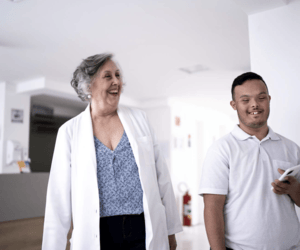
Strategies for Supporting Individuals with I/DD When Receiving Medical Care
This course focuses on working with individuals with intellectual and developmental disabilities (I/DD). It will equip you with the knowledge and skills you need to understand and support this population effectively. The course covers a variety of topics that are relevant to I/DD, providing a comprehensive understanding of the unique behavioral health challenges that individuals with I/DD face.
You will gain insights into the specific behavioral, emotional, social, and medical challenges individuals with I/DD may experience and how these challenges can manifest in various settings. You will see that medical conditions are often at the core of challenging behavior in individuals with I/DD.
Furthermore, the course will emphasize the importance of person-centered approaches and individualized care when working with individuals with I/DD. You will explore strategies for establishing rapport, building trust, and effectively communicating with individuals with communication difficulties. Collaboration with families, caregivers, and interdisciplinary teams will be crucial to supporting individuals with I/DD. You will understand the importance of involving family members and caregivers in the treatment process and collaborating across Colorado's system of care.
Completing this course will enhance your ability to provide compassionate and effective support for individuals with Intellectual and Developmental Disabilities, promoting their behavioral health and overall well-being.

Strategies to Optimize Patient's Experiences in Healthcare Settings
This course is designed to improve interactions with patients in healthcare settings, whether in person or through other modalities (e.g., telephone, online). You will learn strategies relevant to behavioral healthcare within these settings and an overview of skills you can use to interact effectively with patients experiencing various symptoms and concerns.